Last updated June 30, 2026
Seasonal Gate Repair Care for Rancho Cordova: Year-Round Homeowner’s Guide
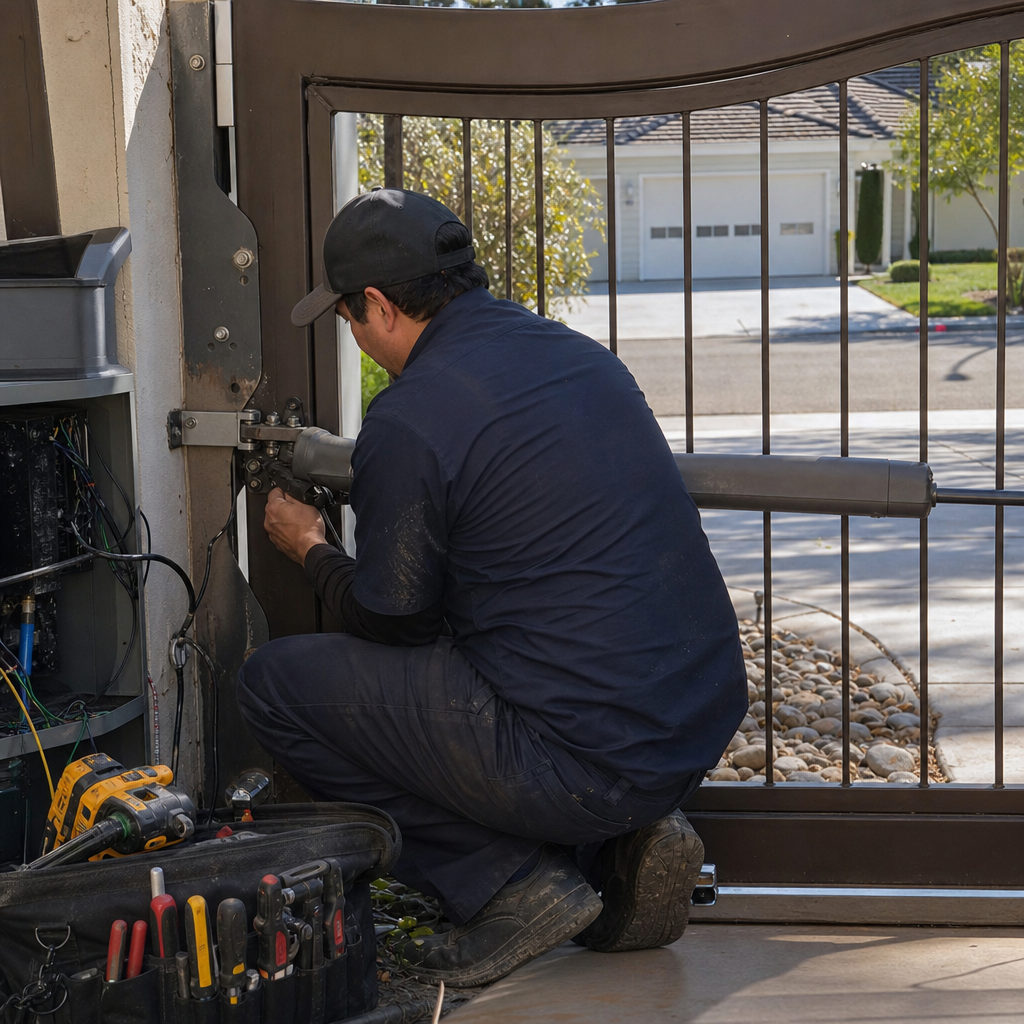
Every August, Eric King gets a wave of calls about gates that “just stopped working” — and in about half of them, the motor’s thermal cutoff tripped because the gate was doing the same work it always did, just in 108°F air instead of 75°F air. That’s not a motor failure. That’s a heat management problem that could have been caught in June. Rancho Cordova doesn’t have a gentle climate — it swings from hard winter freezes near 28°F all the way to triple-digit summer peaks, and each season targets a completely different part of your gate system. This guide breaks down exactly what’s happening to your gate in every season and what to check before a manageable issue turns into a motor replacement or a weld-up.
Quick Answer
Maintaining a gate in Rancho Cordova means addressing four distinct seasonal threat profiles — summer heat stress on motors and duty cycles, fall debris accumulation on sensors and tracks, winter freeze damage to hydraulic operators and hardware, and spring hinge and weld inspection before thermal expansion worsens any misalignment. A focused 15-minute walkthrough each season, timed to calendar reminders, catches the failures that cause complete gate shutdowns and expensive repairs. If you find something you’re unsure about, Ampm Gate Repair Services Rancho Cordova offers free estimates and Eric King personally assesses every job.
Table of Contents
- Summer: Heat Stress, Duty Cycles, and Motor Thermal Shutdown
- Fall: The Debris Season Nobody Talks About
- Winter: Freeze Damage, Hydraulics, and Hardware Failure
- Spring: Hinge Wear, Weld Cracks, and Alignment Before It Gets Worse
- Your 15-Minute Seasonal Walkthrough (With a Photo Checklist)
- Common Mistakes to Avoid
- When to Call a Professional
- Frequently Asked Questions
- The Bottom Line
Summer: Heat Stress, Duty Cycles, and Motor Thermal Shutdown
Summer is the season that kills motors in Rancho Cordova — not dramatically, but quietly, over weeks of accumulated heat stress. When ambient temperatures climb past 100°F, which happens regularly in the Gateway Oaks and Anatolia neighborhoods from late June through September, your gate motor is working in conditions it was never tested for at the factory. Most residential gate motors are rated for duty cycles — meaning they’re designed to open and close a certain number of times per hour before they need to rest and cool down. In 75°F weather, that cooling happens fast. In 108°F air, it doesn’t happen at all.
What follows is thermal cutoff activation: a built-in protection that shuts the motor down before the windings burn out. That’s the protection doing its job. The problem is that repeated thermal cycling — tripping and resetting, day after day through a Sacramento Valley summer — degrades internal components over time and can eventually cause permanent motor damage. LiftMaster residential operators are particularly predictable in this way; when we diagnose a “random lockout” call in August, a thermal trip is the first thing we check.
What to check before summer peaks:
- Clear any brush, weeds, or debris from the motor housing — anything that traps heat against the casing makes thermal management worse.
- Confirm the gate’s travel path is unobstructed. A gate straining against an overgrown post or a dragging weld seam works harder, generates more heat, and eats duty cycle faster.
- Listen for the motor during a full open-and-close cycle. Labored, grinding, or unusually slow movement is a sign the motor is already working beyond its design load.
- Check solar panel connections on solar-powered operators — summer sun is abundant, but loose connections or a failing battery can cause erratic behavior even when daylight is plentiful.
- Test your gate during the hottest part of the day (2–4 PM) at least once in June. If it fails then, you’ll know before it becomes a problem every day in July.
Fall: The Debris Season Nobody Talks About
The Sacramento Valley’s fall is underestimated as a threat season because the temperatures feel like relief after summer. But from October through early December, Rancho Cordova sees steady leaf fall, valley oak debris, and windblown material that quietly buries the components closest to the ground — and those are the components that stop gates cold without any obvious warning sign.
Ground-contact sensors are the primary victim. Photo-eye safety sensors mounted low on swing and sliding gate posts collect leaves, pine needles, and fine debris on their lenses in just a few weeks. A partially blocked photo-eye doesn’t always prevent operation — sometimes it causes intermittent reversals, delayed cycles, or erratic behavior that looks like a failing control board when the fix is a lens wipe and a leaf clear. We’ve seen property managers in the Mather area spend money on diagnostic service calls that resolved with a 30-second cleaning.
For sliding gates, track accumulation is the other fall problem. A gate track filled with wet, compressed leaves forces the motor to work against extra drag every cycle. Over a season, that extra load stresses the drive gear and, in chain-drive operators, accelerates chain wear.
Fall maintenance checklist:
- Blow or brush the gate track clear of leaves and debris — do this monthly from October through December, not just once.
- Wipe photo-eye lenses with a clean cloth. Verify the indicator light shows a clean, unobstructed beam.
- Inspect the area around buried loop detectors (if you have them) for soil displacement or cracking from tree roots — fall is when root pressure often becomes visible after summer growth.
- Check the gate’s bottom seal or kick plate for embedded debris that could misalign the gate’s travel path on the track.
- Test the safety-reverse function by placing an obstruction in the gate’s path during a close cycle. If it doesn’t reverse cleanly, the sensor system needs attention before winter.
Winter: Freeze Damage, Hydraulics, and Hardware Failure
Rancho Cordova doesn’t get sustained hard winters, but the occasional freeze — particularly in January when overnight lows can dip into the upper 20s — creates specific and predictable hardware failures that most homeowners don’t connect to cold weather until it’s too late.
Hydraulic swing gate operators are the most vulnerable. Units like those in the FAAC and BFT product lines use hydraulic fluid to drive the arm, and hydraulic fluid thickens significantly in cold temperatures. A fluid that flows correctly at 50°F becomes sluggish at 30°F, and a gate that runs normally in fall may barely move — or not move at all — on a hard freeze morning. If the motor is forcing a stiff hydraulic circuit, that’s strain on the pump internals. Repeated freeze-thaw cycling without addressing the fluid viscosity issue can lead to pump seal failure.
Standard worm-drive and electromechanical operators aren’t immune either. Lubricants in the drive assembly thicken in the cold, and any existing wear in gears or bearings becomes amplified when the lubricant isn’t flowing properly. Steel hardware — hinges, bolts, locking brackets — contracts in the cold and can crack or shear if they were already corroded or stress-fractured from summer thermal expansion.
Winter checklist:
- If you have a hydraulic operator, confirm the hydraulic fluid grade is appropriate for your climate range. This is a technician-level check — incorrectly specified fluid is a common source of winter failure.
- Inspect all exposed hinge hardware and gate bolts for rust or surface cracking before the first freeze.
- Test the gate’s full range of motion on the first cold morning of the season (below 35°F). Sluggishness or hesitation is a red flag.
- Keep the gate track and bottom channel clear of standing water that can freeze and physically block travel.
Spring: Hinge Wear, Weld Cracks, and Alignment Before It Gets Worse
Spring is the diagnostic season — the window between winter stress and summer heat load when your gate is most honestly showing you what the past year did to its structure. In Rancho Cordova, March through May brings moderate temperatures and the first rains, which are excellent conditions for a detailed structural inspection. What you find now, you can fix before summer thermal expansion makes every alignment problem measurably worse.
Hinge wear is the spring priority. A gate that hung perfectly after installation three years ago develops hinge slop gradually — fractions of a millimeter at a time — until the gate sags enough to drag on the ground, bind at the latch, or misalign with the motor arm. Sagging gates that drag through summer do so against constant heat-swelled steel, which means the wear accelerates. Catching hinge fatigue in April, when the metal is at its most stable temperature, gives you a clean baseline for adjustment or replacement.
Weld cracks are the other spring concern. Steel gate frames expand and contract with every seasonal temperature cycle. Hairline cracks in weld seams — particularly at corner joints and at the mounting bracket where the motor arm attaches — are small in winter but can open significantly under summer expansion. We handle structural welding in-house, which means we can address a cracked frame section on the same visit as a motor check, without outsourcing metalwork or scheduling a second appointment.
Spring structural checklist:
- Open the gate manually (disengage the motor) and check for sag by observing where the bottom rail sits relative to the ground across the full swing or slide range.
- Physically grip each hinge and test for play in any direction. Any movement beyond what the hinge design allows means it’s worn or the mounting bolts have loosened.
- Inspect all visible weld seams — especially corners and the motor bracket — for hairline cracks or rust bloom that signals metal fatigue underneath.
- Check the gate’s latch or strike point for misalignment. A latch that required force to engage in winter is a misalignment indicator, not a latch problem.
- Reconnect the motor and run a full open-and-close cycle. Listen for any new sounds — clicking, grinding, or a hesitation at a specific point in travel that didn’t exist last fall.
For our Gate Repair in Rancho Cordova customers, spring is consistently our busiest structural repair window — and for good reason. Addressing these issues before the heat arrives keeps repair costs down and prevents mid-summer failures.
Your 15-Minute Seasonal Walkthrough (With a Photo Checklist)
A systematic seasonal walkthrough doesn’t require tools or technical knowledge — it requires consistency and documentation. Build this into a calendar reminder four times per year: late May, late August, late October, and late January. The timing catches each season’s threat profile before it peaks.
The 15-minute walkthrough, step by step:
- Photograph the gate in its closed position — full frame, both sides if accessible. Date-stamped photos create a before-and-after record that’s useful for insurance claims and for showing a technician what changed between visits.
- Run three open-and-close cycles while watching the gate’s full travel. Note any hesitation, speed variation, unusual sounds, or deviation from a straight travel path.
- Inspect the motor housing for debris accumulation, rust, or physical damage. Check that any ventilation slots aren’t blocked.
- Wipe the photo-eye lenses and verify alignment indicators are reading clean. Test the safety-reverse function.
- Check the track or ground rail (sliding gates) or hinge hardware (swing gates) for the season-specific issues described above.
- Test the access control device — keypad, remote, intercom, or loop detector — to confirm it’s responding correctly. Photograph any error codes displayed on the control panel.
- Document anything new — a sound, a movement irregularity, a rust spot, a crack — in a simple note attached to your photo folder. This log becomes invaluable when describing a problem to a technician.
This walkthrough works equally well for a newly installed gate in Rancho Cordova as it does for a gate that’s been running for fifteen years. The specific things to watch shift as the gate ages — newer gates need baseline documentation, older gates need close structural scrutiny — but the process is the same.
For gates connected to DoorKing or Elite access control systems, add a step to log the entry count or check the system’s diagnostic log if accessible. These systems track usage in ways that can flag unusual activity or help explain a component failure pattern.
Common Mistakes to Avoid
- Using the wrong lubricant on gate hardware. WD-40 is a solvent, not a gate lubricant — it cleans and temporarily displaces moisture but doesn’t provide lasting protection for hinges, tracks, or chain drives. Use a lithium-based grease or a lubricant specified for gate hardware; the wrong product accelerates wear rather than reducing it.
- Ignoring thermal cutoff trips as one-time events. When a gate stops working in summer heat and then “comes back on its own” after an hour, that’s a thermal cutoff trip, not a mystery that resolved itself. In Rancho Cordova’s summer climate, repeated trips are a warning that the motor is being pushed past its safe operating range — treating them as isolated incidents leads to motor burnout.
- Setting motor limits too tight in fall, then not readjusting. Some homeowners tighten limit settings in fall to get a cleaner latch engagement, which works fine in cool weather. But tight limits combined with summer heat expansion — when the gate frame itself grows slightly — can cause the motor to stall against an over-travel condition. Limits should be set with seasonal range in mind.
- Neglecting the gate motor and opener battery in winter. Backup batteries in gate operators degrade faster in cold weather. A battery that holds a charge fine in October may not sustain the gate through a power outage in January. Replace backup batteries every two to three years, and test them specifically in cold conditions.
- Skipping the photo-eye safety test after any debris clearance. Cleaning debris from around sensors can inadvertently shift the photo-eye alignment by a few degrees. Always re-test the safety-reverse function after any ground-level cleaning or landscaping work near the gate.
- Attempting structural weld repairs with store-bought welders on load-bearing joints. A hairline crack in a corner joint or motor mount bracket is a structural issue, not a cosmetic one. Improper amateur welding on a load-bearing gate component can fail catastrophically when the gate is under motor load. Gate welding requires experience with the specific metal gauges and joint designs used in gate fabrication — this is not a general home-repair task.
- Delaying hinge replacement because the gate “still works.” A gate with worn hinges that sags 1–2 inches doesn’t fail immediately — it fails your motor first, by forcing the operator to compensate for the misalignment on every cycle. By the time the gate stops working, you’re often replacing both the hinges and the motor. Address hinge wear when you see it.
When to Call a Professional
Call a gate specialist — not a general handyman — in these specific situations: the motor is running but the gate isn’t moving (a stripped drive gear or broken chain, not a DIY fix); the gate reverses unexpectedly mid-cycle and photo-eye cleaning didn’t resolve it (likely a sensor alignment or control board issue); you’ve found a visible crack in any weld seam, particularly near the motor mounting bracket or hinge plates; the gate moves sluggishly in cold weather and you have a hydraulic operator (fluid viscosity or pump seal); or any component of your access control system — keypads, loop detectors, intercoms — stops responding after you’ve power-cycled the unit.
Ampm Gate Repair Services offers free estimates in Rancho Cordova. Eric King personally assesses every job — your call goes to the same person who’ll be at your gate with 19 years of gate-specific experience. Call (279) 256-1348 to schedule.
Frequently Asked Questions
A seasonal check — four times per year — is the right cadence for Rancho Cordova’s climate range. The specific threats change enough between summer, fall, winter, and spring that a single annual inspection misses issues that develop mid-year. A 15-minute walkthrough each season, combined with a professional service call when you find something abnormal, keeps most gates in reliable operation for years beyond their average service life. Call (279) 256-1348 if a walkthrough turns up something you want assessed professionally — estimates are free.
That’s almost always a thermal cutoff trip. Gate motors in Rancho Cordova’s summer heat — regularly exceeding 105°F in the afternoon — hit their thermal protection threshold after repeated cycles in high ambient temperatures. The motor shuts itself off to prevent winding damage, then resets after it cools. This is not a malfunction correcting itself; it’s a warning that your gate’s load, lubrication, or motor capacity needs attention before the protection stops preventing damage. Call (279) 256-1348 to have the duty cycle and load assessed before the problem escalates.
Yes — particularly if you have a hydraulic swing gate operator. Hydraulic fluid thickens in temperatures below freezing, and forcing a stiff hydraulic circuit under motor power stresses the pump seals and internal components. Even electromechanical operators experience gear and bearing stress when lubricants thicken in the cold. In Rancho Cordova, hard freezes are infrequent but real — January lows in the upper 20s happen, and they’re cold enough to cause these failure modes in equipment that isn’t prepared for them.
Use a lithium-based grease or a product specifically rated for gate and garage hardware — not WD-40, which evaporates and leaves hardware insufficiently protected. For sliding gate tracks, a dry lubricant or lithium spray works well because it doesn’t attract debris the way wet greases can. Apply lubrication at each seasonal walkthrough, and wipe away old grease before re-applying rather than layering on top, which can mask wear and trap grit.
Repair is usually the right answer when the structural frame is sound — no significant weld cracks, hinge mounting points are solid, and the gate travels straight. Motor, board, and hardware replacements on a structurally intact gate are almost always more economical than full replacement. Replacement makes sense when the frame itself is compromised by corrosion, collision damage, or weld failures at multiple points, or when the gate’s dimensions no longer match your access needs. A professional assessment will tell you which category you’re in — and that assessment at Ampm Gate Repair Services is free. Call (279) 256-1348.
Yes — and it’s one of the most underestimated failure causes we see in fall and early winter. Debris-blocked photo-eyes cause erratic reversals and refused-to-close behavior that looks like a board or motor problem. Debris-packed tracks increase motor load on every cycle, accelerating drive gear and chain wear. Rancho Cordova’s valley oak and landscape tree coverage makes the October–December window particularly active for debris accumulation around gate systems. Monthly track and sensor clearing during this period is genuinely preventive maintenance, not optional housekeeping.
The Bottom Line
Rancho Cordova’s climate is a four-season stress test for gate systems — summer heat loads motors to their thermal limits, fall debris silently sabotages sensors and tracks, winter freezes attack hydraulics and hardware, and spring reveals what the previous year left behind in hinges and weld seams. None of these failures are inevitable if you build a 15-minute seasonal walkthrough into your calendar and document what you find. Address small issues while they’re small. When a walkthrough surfaces something structural, electrical, or outside your comfort level, it’s faster and less expensive to call a gate specialist than to let the problem compound through another season. With 112 reviews averaging 4.9 stars and 19 years of gate-only experience, Ampm Gate Repair Services is built for exactly this kind of preventive work — and Eric King will be the one at your gate.
Schedule Your Seasonal Gate Assessment
If your seasonal walkthrough turned up something you want a second set of eyes on — or if you’d rather have Eric King run the inspection himself — we’re ready to help. Ampm Gate Repair Services serves Rancho Cordova and the surrounding Sacramento area with free estimates and no obligation. We work on LiftMaster, Mighty Mule, DoorKing, Elite, and seven other major gate brands, and we handle structural welding, motor service, and access control in a single visit. Call (279) 256-1348 to schedule. No dispatch center, no crew handoff — Eric picks up.
Written by Eric King, Owner & Lead Technician at Ampm Gate Repair Services Rancho Cordova, serving Rancho Cordova since 2007.